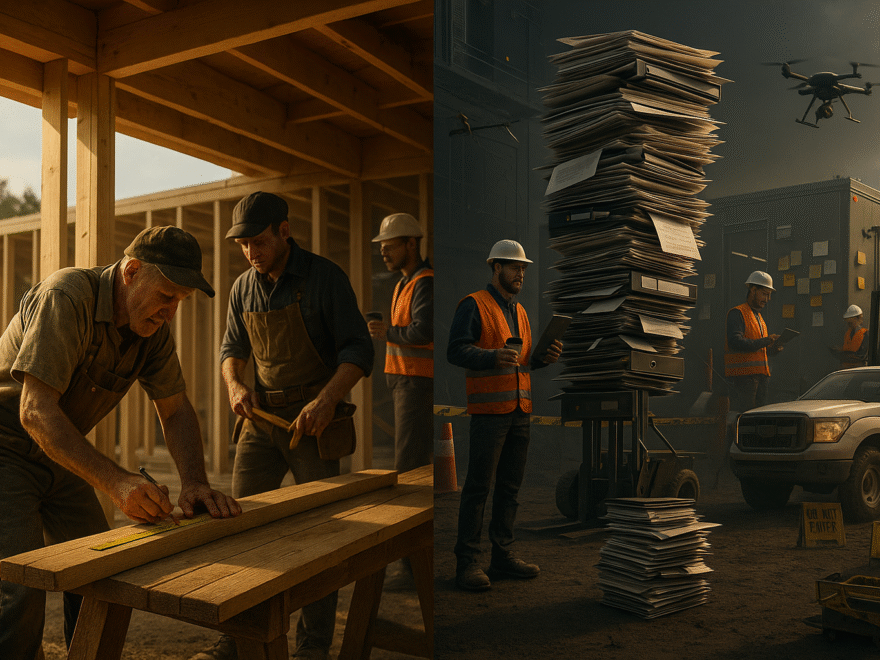
Back When A Hammer And A Ladder Got The Job Done
The Bloat Problem We Pretend Is Normal
Modern construction feels like ordering a sandwich and getting charged for someone to describe the lettuce. Layers of managers, coordinators, and consultants orbit a site while the actual work moves at the speed of a clipboard. A small bathroom reno now has a kickoff, a handoff, three standups, and a postmortem. The bill includes ten hours of “mobilization” and a line item called “project cadence.” Translation. Meetings.
Costs balloon because complexity sells. The pitch is always the same. Extra oversight will save money. It rarely does. The machine exists to feed the machine. You pay for time sheets, branded vests, and a Slack channel with six people typing “quick update.” 🤠.
Then Versus Now
Then. Two trades, one truck, a plan on graph paper, and a quote that fit on a sticky note.
Now. Twelve trades, four trucks, cloud folders, legal reviews, and a quote that needs a decoder.
Then. Real wood. Fast decisions. Accountability.
Now. “Value engineering” that values accounting over engineering, plus a warranty that expires the day you finally find it.
Then. Build it to outlast you.
Now. Build it to survive the inspection, the social post, and quarter end.
People Forgot How To Build
The basic sequence of home construction used to be sacred. Measure, cut, fit, check, fix, finish. Today it is often present, export, escalate, rescope, and schedule a follow up. Skill has been replaced by software. There is a belief that enough dashboards will make the joint plumb. They do not. A house still responds to gravity and water, not memos.
Look at older homes that are still square after 70 winters. Balloon framing that is somehow straighter than the engineered product next door. Lime mortar that breathes. Floors that were laid once and never squeaked. That happened because the builder had a standard higher than the contract.
The work carried their name. Not a logo. Their name.
Why It Got This Way
- Risk offloading. Companies pad the process to manage liability. Many layers, minimal responsibility.
- Marketing over mastery. It is easier to sell “systems” than sharpen a hand plane.
- Subcontract daisy chains. Everyone takes a slice. Few own the result.
- Procurement theatre. Lowest bid wins, then change orders win bigger.
- Talent gap. Fewer mentors on site, more middle managers off site.
None of this makes your roof straighter.
What Endures From The Old School
- Simple scopes. Clear drawings, no murky footnotes.
- Direct ownership. A foreman who knows your address without opening an app.
- Correct materials. Wood, fasteners, membranes, with proper compatibility, installed correctly.
- Right order of operations. Air, water, vapor, thermal. Respect physics and you spend less on patching.
- Continuous presence. The same carpenter shows up tomorrow. Continuity saves time and quality.
How To Hire Lean In A Bloated Market
- Ask for the site lead’s name, not the sales lead’s name. You want the person who will be there when the rain starts.
- Demand a scope that fits on two pages. If it needs a novel to explain, it hides a novel of surprises.
- Price the finish line, not the starting gate. Fixed price for a complete result with defined allowances, not hours for “coordination.”
- Check old work with your boots, not a brochure. Go stand on a deck they built five years ago. Listen for the squeak.
- Favour crews that self perform critical tasks. Less pass-the-baton, more hands that remember what they did yesterday.
- Look for tools with scars. A beat up level belongs to someone who builds. A pristine white hard hat belongs to someone who attends.
When Complexity Is Actually Legit
There are times when extra brains help. Structural changes, heritage details, commercial codes, and building science in tough climates. The difference is purpose. Added expertise should speed decisions and raise quality, not multiply meetings. If complexity does not shorten the schedule or reduce rework, it is performance for the invoice.
A Small, Honest Renovation Checklist
- The person quoting can explain every step in plain language.
- Materials are specified by brand and model, not vibes.
- You get a start date and a realistic finish date, not a season.
- There is a daily cleanup plan. People who clean as they go care about results.
- Change orders are rare and triggered by surprises in the walls, not surprises on the spreadsheet.
Humor Break, Because We Need It
If a contractor shows up with a drone, a gimbal, and no tape measure, you are getting a documentary, not a kitchen. If the estimate includes “content strategy,” they are planning to post your drywall before they install it. If there are more pastel mood boards than saw blades, prepare your wallet.
The Forward Path. Build Like You Mean It
We can respect modern safety and code without worshipping bureaucracy. The fix is not nostalgic cosplay. It is practical discipline. Smaller teams with authority like Towns Construction from Calgary, Alberta. They’ve lived and breathed the old ways for many years. Clear scopes. Fewer handoffs. Materials that prefer screws over slogans. Teach apprentices. Reward craft. Put money into the hands that touch the work and delete roles that only touch the calendar.
Final Word
Old builders were not magicians. They were focused. They put more time into the cut than the caption. If we bring that back, houses get straighter, projects get shorter, and invoices get smaller. The bloated monster does not survive contact with a crew that knows what it is doing and shows up with a plan, a ladder, and a pencil that is shorter every week.
Calgary Construction Company with Heart
A renovation and construction company from Calgary, Alberta with the heart and soul of the good old days: