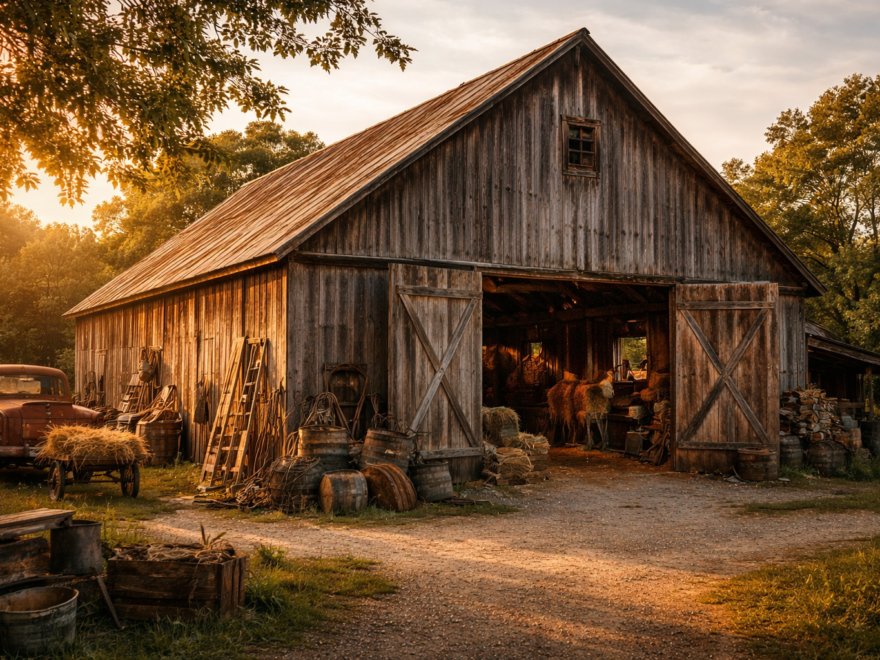
Before storage units, we had barns
There was a time when people did not pay a monthly fee to forget what they owned.
That alone feels worth saying.
Now we rent little numbered boxes in long beige hallways under fluorescent light, punch in a code, lift a metal door, and stand there staring at the physical remains of decisions we were not ready to make. Old chairs. Half-used tools. Christmas bins. Baby clothes. Broken lamps. A treadmill that once represented hope. The whole thing feels less like storage and more like outsourced hesitation.
And somehow this became normal.
It did not used to be normal.
We used to have less. Less stuff, yes, but also less confusion about what stuff was for. A table was a table until it broke. A trunk held what mattered. Tools had owners. Winter things went away in winter. Summer things came back in summer. What did not fit in the house went to the barn, because the barn was not some polished retail solution invented to monetize overflow. It was just there. Solid. Useful. Honest.
A barn did not pretend to improve your life. It simply absorbed part of it. (quote that!)
That is the difference.
Storage unit facilities feel like a symptom. Barns felt like infrastructure.
One is built around excess. The other was built around living.
People like to say times were simpler back then, and usually that phrase gets abused by people trying to flatten history into nostalgia. Life was not easier in every way. It was harder in plenty of ways. Colder. Rougher. More demanding. But there was a clearer relationship between a household and its belongings. You knew what had a use. You knew what had a season. You knew what could wait. And if something piled up, if the harnesses, crates, spare boards, seed sacks, tools, bins, and family odds and ends started pressing against the walls of the house, there was a barn.
Not a facility off the highway.
A barn.
Close enough to walk to in boots. Big enough to hold the untidy edge of a real life. Ugly in the best way. Dusty, drafty, deeply competent. It did not need branding. It did not need climate control to flatter itself. It had room. That was enough.
And maybe that is part of what people miss without realizing it.
Not barns exactly, though some do miss barns. What they miss is the older logic. The permission to have a place that was not curated, not optimized, not part of some monthly subscription model. A place where life could spill over a little without becoming a problem to be packaged and billed.
Barns belonged to a culture that understood overflow.
Modern storage units belong to a culture that profits from it.
That is not the same thing.
A barn said: we know life gets messy.
A storage facility says: we know, and we have a payment plan.
That sounds harsher than it is. Storage units solve real problems. People move. Parents die. Houses shrink. Marriages end. Businesses need room. Cities pack people tighter and tighter, then act surprised when nobody has space for a ladder, let alone a chest freezer or twenty years of family furniture. Sometimes a storage unit is the practical answer. Fine. Fair enough.
But practical answers still reveal something about the age that produced them.
And ours has produced a strange one.
We have smaller homes stuffed with more things, less family land, fewer outbuildings, fewer rooted places to put anything, and a whole industry built around the overflow. Not because we suddenly became wicked or foolish, but because we stopped building our lives with extra edges. No sheds worth much. No workshops. No barns. No unclaimed square footage with a dirt floor and a roofline older than our worries.
So we drive to a facility instead.
The old barn was never just storage anyway. That is another thing the polished metal hallway can never imitate.
A barn held tools, yes. But it also held weather. Time. Smell. Noise. It held the side of life that was too dirty or too awkward or too seasonal for the main house. Barns made room for the rougher textures of living. You could stack lumber in there. Hang tack. Store old windows, buckets, fencing, and the odd machine that might still be useful if somebody had half a Saturday and the will to tinker. A barn was memory without ceremony. Utility without shame.
You did not have to label every plastic tote and build a spreadsheet around it.
You just knew what was in the barn.
Or roughly knew, which was often enough.
And yes, plenty of barns were full of junk. Real junk. Not everything old deserves a halo. Sometimes a barn was just where things went to rot more slowly. But even that felt more human than this modern obsession with preserving every object in a secure, coded, surveilled box two towns over. At least the barn kept your clutter in the same moral universe as your life. It belonged to the property. It aged with the family. It sat under the same sky.
There is something to that.
Something steadier.
The storage unit feels temporary even when it lasts ten years. The barn felt permanent even when it was leaning.
One was an extension of home.
The other is a receipt.
And maybe that is what this really comes down to. Not barns versus storage units in some literal, practical sense. Most people are not about to trade their townhouse for ten acres and a gambrel roof. That is not the point. The point is that we used to live with a little more acceptance of material life in its natural state. We had room for useful clutter. Room for tools. Room for weathered things and delayed decisions. Room for the evidence of work.
Now we want everything tucked away, professionally managed, and aesthetically distant from the main performance of our lives.
But life is not that clean.
It never was.
The barn knew that.
It did not judge your pile of offcuts, your rusted hardware, your cracked chairs waiting for repair, your boxes of family spillover. It just stood there and held it. Quietly. Without a monthly reminder. Without a late fee. Without pretending your excess was a premium lifestyle service.
That is why the barn still has a hold on people, even now.
Not because it was perfect. Because it was real.
It belonged to a world where people expected life to come with weight, and built places sturdy enough to carry it.
And if that world had a little clutter in it, so be it.
At least the clutter had the decency to stay in the barn.
For people interested in the cultural value of old rural structures, Ontario Barn Preservation is a good reminder that barns were never just utility buildings. They were part of the shape and memory of rural life.
The same idea shows up in broader heritage conversations across the country. The National Trust for Canada’s look at historic barns makes the point plainly: these buildings still carry value long after the modern economy has decided they are inefficient.
Ontario has even had to think seriously about the cultural meaning of rural farmsteads, because old agricultural properties are more than just leftover land with weathered buildings on them. The province’s material on rural historical farmsteads says a lot without meaning to. These places mattered. They still do.
By contrast, the modern storage world is now a full industry with trade groups, data, expansion, and market language of its own. You can see that clearly through the Self Storage Association, which tells you everything you need to know about how overflow went from household reality to organized business model.
That may be efficient. It may even be necessary now.
But it is not more soulful than a barn.