It Didn’t Used to Be Like This
Every summer now, the sky becomes evidence.
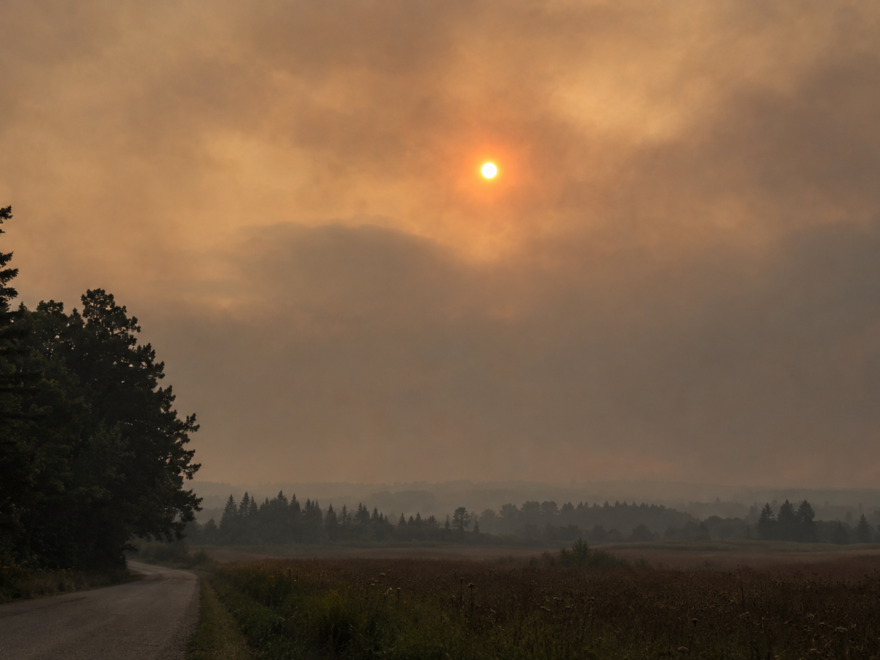
The sun turns orange in the middle of the afternoon. The horizon disappears behind a grey-brown curtain. Cars collect a fine layer of ash despite being parked hundreds of kilometres from anything visibly burning.
Then comes the smell.
Not the honest smell of a campfire or woodstove. This is thinner, stranger and harder to place. It slips through windows, settles into clothing and makes an ordinary July afternoon feel vaguely wrong.
We check the weather, but the weather is no longer enough. Now we check the air.
This did not used to be part of summer.
The Fires Were Always There
Canada has always burned.
Fire is part of the natural life of the boreal forest. It clears old growth, releases nutrients and allows certain species to regenerate. Indigenous communities used controlled fire for centuries before modern governments decided that every flame in the forest was an enemy.
There were also terrible fire seasons long before anyone had an air-quality app on a telephone. Towns burned. People were evacuated. Smoke travelled great distances.
So the claim that wildfires are new would be wrong.
But that is not really what people mean when they say, “It didn’t used to happen.”
They mean the smoke did not used to arrive like this.
They mean it did not regularly swallow entire provinces, cross national borders and turn the sky over cities that had never considered themselves part of wildfire country.
They mean summer did not come with instructions to keep the windows closed.
The Year the Scale Changed
For many people, 2022 feels like the dividing line. The calendar may argue over the exact year, particularly in Western Canada, where the warning signs arrived earlier. But 2023 was when the change became impossible for the rest of the country to ignore.
That year, more than 14.6 million hectares burned across Canada. It was roughly four times the recent national average and more than double the previous record. The fires were not confined to one dry corner of the country. They burned from the Atlantic to the Pacific and deep into the North.
More than 230,000 people were evacuated. Smoke from Eastern Canada spread over major Canadian and American cities, leaving more than 100 million Americans under poor air quality. Some of it crossed the Atlantic and reached Europe.
Those are not the numbers of a difficult summer.
They are the dimensions of an event.
Natural Resources Canada called 2023 the country’s [most destructive wildfire season on record](https://natural-resources.canada.ca/stories/simply-science/canada-s-record-breaking-wildfires-2023-fiery-wake-call). The organization also noted something unusual about it: the fires were widespread. Canada was not dealing with one regional disaster. Much of the country was burning at once.
That distinction matters.
A large fire is an emergency. A continent under smoke is a condition.
Smoke Became Weather
For most people, the defining image of a wildfire used to be flames moving through trees.
Now it is a skyline fading behind smoke.
The fire can be a thousand kilometres away and still change the day. Outdoor work is postponed. Sports are cancelled. Children stay inside. People with asthma watch the air-quality number climb and make quiet calculations about how much breathing they can afford to do outdoors.
Smoke has become weather, except it does not fall from the sky and move on.
It lingers.
Wildfire smoke contains fine particulate matter known as PM2.5. The particles are small enough to travel deep into the lungs and enter the bloodstream. The danger is not limited to communities beside the fire. Smoke can travel hundreds or thousands of kilometres, spreading the consequences across populations that never see a flame.
The change has started to appear in Canada’s air-quality record. For the 2021 to 2023 reporting period, the federal government found that 14 percent of Canadians lived in areas exceeding national annual standards for fine particulate matter, [largely because of wildfire smoke](https://www.canada.ca/en/environment-climate-change/services/environmental-indicators/population-exposure-outdoor-air-pollutants.html).
Then 2025 brought another summer of drifting smoke. Winnipeg, Regina, Saskatoon and Prince Albert experienced their smokiest July on record. By 2026, smoke was again moving across the Great Lakes and into the northeastern United States.
Once is an event.
Again is a pattern.
The Match Is Not the Whole Story
Every bad fire season brings the same argument.
Someone points to lightning. Someone points to arson. Someone blames careless campers, poor forest management, logging policy or governments that spent too little preparing for the inevitable.
Some of those arguments contain truth.
Fires need an ignition source. People start many of them, sometimes accidentally and sometimes deliberately. Forest management matters. Decades of suppressing smaller fires can leave more fuel on certain landscapes. Communities built against forests are harder to defend. Equipment, access roads and available firefighting crews all affect what happens after the first spark.
But a match does not explain why the ground is ready to burn.
The broader conditions are changing. Warmer temperatures draw moisture from soil and vegetation. Snow melts earlier. Drought lasts longer. Fire seasons stretch further into spring and autumn. When several regions experience those conditions at once, ordinary ignitions can produce extraordinary results.
Natural Resources Canada says Canada’s fire season has become longer. In 2023, it ran from the middle of April until late October. Early snowmelt, prolonged drought, moisture deficits and record heat aligned across enormous portions of the country.
A major study of that season found the average Canadian temperature from May through October was 2.2°C above the 1991 to 2020 average. The researchers concluded that human-caused climate change helped sustain the extreme fire weather behind the record season.
Climate change does not walk into a forest carrying gasoline.
It changes the forest’s odds.
The Strange Comfort of Arguing About It
There is comfort in blaming one person, one policy or one badly managed patch of land.
A specific failure can be corrected. A criminal can be arrested. A government can clear brush, buy aircraft or hire more firefighters. The world can be returned to its proper order.
A changing climate is harder to hold.
It has no single face. It does not arrive on one particular morning. It works by degrees, averages and probabilities until something once considered unusual begins happening often enough to feel ordinary.
That is the unsettling part.
People are remarkably good at adjusting to decline. We buy air purifiers. We learn what an Air Quality Health Index of seven means. We move the barbecue indoors, cancel the baseball game and wait for the wind to change.
A strange sky becomes a bad-air day.
A bad-air day becomes smoke season.
Smoke season becomes summer.
Memory Is Not a Scientific Instrument
It is fair to be suspicious of the phrase “I don’t remember this.”
Human memory is selective. Childhood summers seem longer because childhood was slower. News travelled differently. There were no satellite smoke maps in every pocket, no alerts appearing automatically on every telephone and no social feed filled with photographs of an orange sun.
We also remember local weather better than distant disasters. A fire that burned in northern Manitoba in 1989 may have been enormous, but it remained an item on the evening news for someone living in southern Ontario. Today, the smoke can arrive at that person’s front door.
Better information makes some of the change more visible.
It does not create the change.
The burned area, duration of the season, reach of the smoke and repeated air-quality records are measurable. The four most severe wildfire seasons in British Columbia’s past half-century occurred between 2017 and 2023. Canada’s 2023 season burned more than twice the land of the previous national record.
Memory may be imperfect.
The numbers are not nostalgic.
The New Colour of Summer
There was a time when an orange sky meant evening.
Now it can mean forests are burning somewhere beyond the horizon.
The fires did happen before. Some were enormous. Some years were terrible. No honest account of Canadian history can pretend otherwise.
But they did not combine so often with heat, drought and continental smoke to become a shared condition of life. They did not repeatedly make people in Toronto, Montreal, New York, Chicago and Washington look upward and wonder what had happened to the sun.
Something is different.
We can debate exactly when it began. We can argue over causes, responsibility and what should be done. Those arguments are necessary, but they should not be used to obscure what is directly in front of us.
The old summer sky is becoming less dependable.
We are not waiting for the change anymore.
We are breathing it.